
The Science of Yoga for Neurodivergent Individuals: 5 ways to soothe overstimulation

What Is Overstimulation?

Overstimulation happens when our brains and bodies receive more input than we can comfortably process. This can come from many sources — sensory overload, difficulty communicating, feeling misunderstood, too much social interaction, emotional overwhelm, or even complex tasks that demand intense focus (just to name a few!).
For neurodivergent individuals, sensory processing differences can make this overwhelm more frequent and intense. The brain may rapidly switch into a stress response (fight, flight, freeze, or fawn), showing up as agitation, anxiety, meltdowns, or withdrawal.
Sensory input doesn’t just include what we see, hear, taste, touch, or smell. It also involves our vestibular (balance and movement) and proprioceptive (body or spatial awareness) systems. Some people are
sensory seeking (craving input), others are sensory avoiding, and many are mixed depending on the sensory system involved eg. seeking deep pressure whilst being incredibly sensitive to sound.
How Yoga Helps
Yoga — which includes asana (movement), pranayama (breathwork), and meditation — has been well-researched for its effects on both mental and physical health.
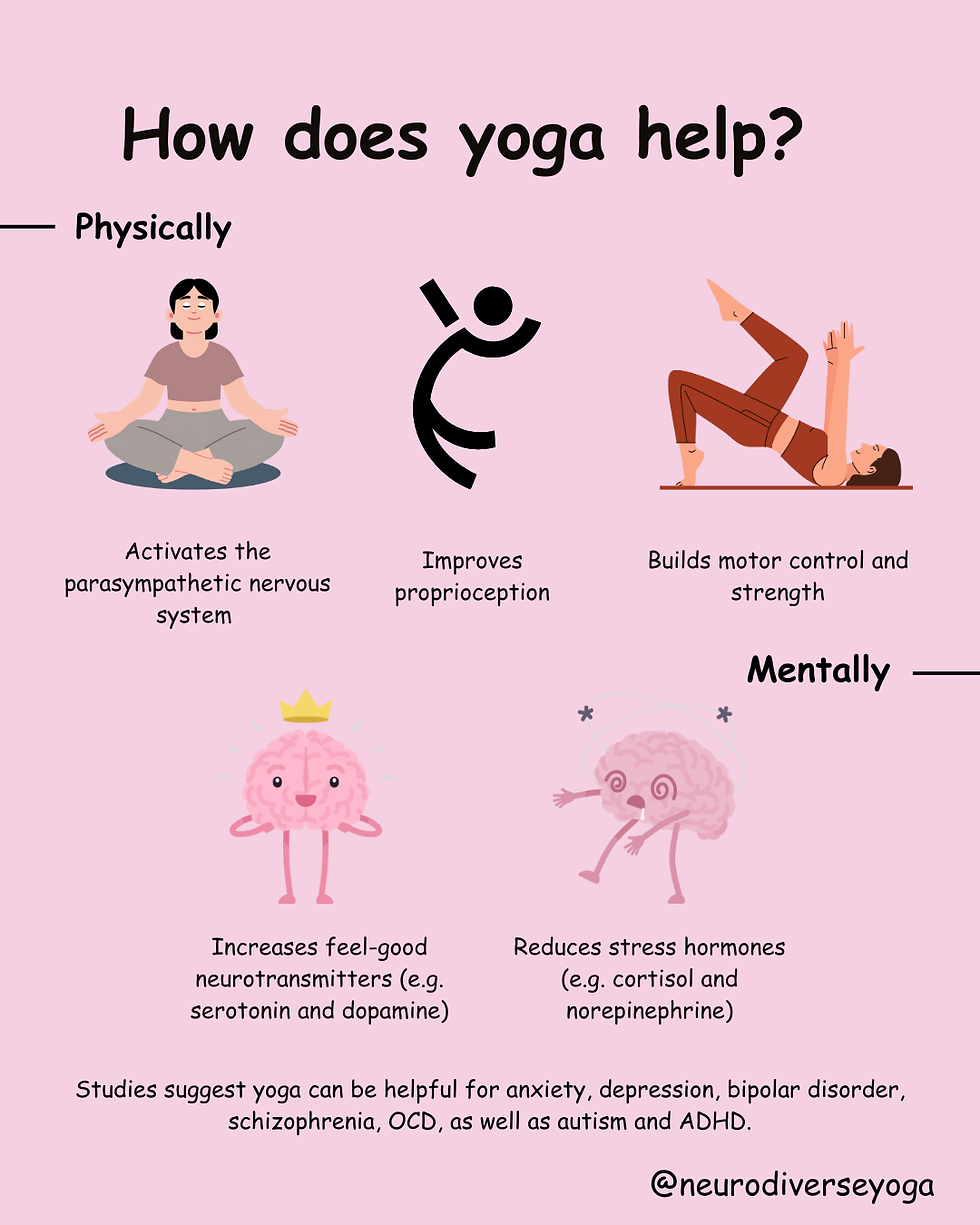
Regular yoga practice can support sensory integration and improved proprioception, better motor control and strength, and help activate the parasympathetic nervous system (our “rest and digest” state).
Physiologically, yoga has been shown to increase feel-good neurotransmitters like serotonin and dopamine, while reducing stress hormones such as cortisol and norepinephrine. Studies suggest yoga can be helpful for anxiety, depression, bipolar disorder, schizophrenia, OCD, as well as autism and ADHD.
Here’s five ways you can use yoga as a tool to soothe overstimulation
What’s best for you may depend on your sensory preferences or co-occurring conditions but here are some suggestions:
1. Yoga as Stimming (self-soothing/stimulating ‘behaviours)
Yoga can offer safe, rhythmic movement, repetition and vocalisations that can mirror stimming — a protective response to overwhelm.
You could try:
Rocking, swaying, or circling movements especially when stillness is asked for or expected. I do this freely now in yoga classes, mostly in seated, all fours or child’s pose when I feel comfortable to rock, sway or make circling movements. You could try a more organic cat-cow that includes hip circles, rocking side to side or simply shifting your weight across your hands and then your knees. Movements can be as small or large as you like, explore what feels best in your body.
Chanting or humming can mimic echolalia (or a vocal stim) which can help stimulate the vagus nerve to shift to a calmer parasympathetic state. If this is something that’s already in your practice, you might already find it helps you to regulate by creating a sense of safety through familiarity. If you haven’t tried chanting before you could listen to some simple chants or just practice a simple extended Om sound.
Stimming can help discharge energy, regulate the nervous system, and create a soothing rhythm. I’ve learnt to embrace this in neurotypical yoga classes and not to feel as self-conscious when my om’s sound a bit wobbly!
2. Proprioceptive and Vestibular Feedback
The proprioceptive system lives in our muscles and joints. It gives us body awareness — helping us sense pressure, force, and body position.
Proprioceptive input, especially through ‘heavy work’ is deeply calming, especially for those who experience sensory overload. In yoga, you can activate it through:
Weight-bearing poses: Downward Dog, Plank, Chaturanga, Chair Pose
Deep pressure or grounding: Crocodile Pose, Baby Cobra, or Forward-Facing Savasana (lying belly-down)
By adding weighted props during restorative poses — sandbags on the belly, or across the bottom of the feet during legs up the wall
Simply wearing tight activewear or compression clothing whilst doing yoga can also provide this same deep pressure sensation. This may cause sensory issues however, so if loose clothing is your preference, then stick with it.
The vestibular system in our inner ear provides our brain with information about balance, motion and spatial orientation, but is also closely connected to the part of our brain where we regulate emotions.
Gentle vestibular challenges — twists, inversions, and balancing postures can help sensory integration and calm the nervous system. I’m a bit sensitive to vestibular challenges so find poses where I’m anchored to the ground more settling. I’ll also often practice these poses with my eyes closed when it’s safe to do so to reduce some of the visual input. In yoga, maintaining a drishti, or visual point of focus can also help with balance as well as mental clarity through a drawing inward of the senses.
3. Restorative Poses for the Parasympathetic Nervous System
Restorative yoga invites the body into stillness, signalling safety and allowing the sympathetic (fight/flight) system to switch off. You should never feel you have to stay still however, especially if you’re uncomfortable. Adjust yourself or ask the teacher for more props if you feel you could be more comfortable.
Here’s some examples you could try:
Supported Savasana (with a bolster under the knees, and blankets both underneath and on top of you)
Legs up the wall (Viparita Karani) with a folded blanket or bolster under the sacrum
Supported Child’s Pose (Balasana) hugging a bolster
Supported twist onto a bolster
Focus on sensations in the body, slow your breathing if you can, and prioritise comfort. If focussing on your breathing isn’t right for you then you could try silently repeating a mantra or focus on sounds (I much prefer to do this). You might find some poses more calming than others, personally I like anything forward facing on a mat or a bolster or if the front of my body is exposed then covering myself with a blanket, weighted item or one hand on my heart and one on my belly. I call restorative yoga the business class of yoga…. settle only for maximum comfort!
4. Pranayama (Yogic ‘breathwork’)
Conscious breathing is one of the most direct ways to regulate the nervous system, but it can also be challenging or anxiety provoking for some. Sometimes I find breathing techniques more accessible after an asana practice and not at the beginning of class, and some days, just matching movement to breath through active asana is enough. Some pranayama techniques I do like are listed below:
Extend the exhale – inhale to a count that suits you and then exhale for a longer count. You might like to try an inhale to the count of 4 and exhale to a count of 6. As you get used to it you may be able to increase the count, it doesn’t really matter what numbers you use, just as long as the exhale is longer. You could even use a mantra (word or repeated sound) instead of counting
Viloma breath – this is a favourite of mine and translates to ‘against the order’ (of the breath). Viloma is a three-part breath, gently fill your lungs to around 1/3 capacity then hold for a moment, then sip in more air through your nostrils to 2/3 capacity, pause, and then fill your lungs completely, pause and then exhale in one long breath.
Nadi Shodhana (alternate nostril breathing) – I also like this one but there’s so many other techniques you can try if it’s not for you. Use your thumb to close the right nostril and your ring finger to close the left. Start by closing your right nostril with your thumb and inhale slowly and deeply through your left nostril. Then switch to closing your left nostril with your ring finger, release the thumb, and exhale through the right nostril. Inhale back through the right nostril, then close it with your thumb, release the ring finger, and exhale through the left. Continue for as long as you like, stopping and returning to natural breathing if you don’t like it.
5. Mindfulness
Mindfulness practices not only help activate our parasympathetic nervous system, but they may help build interoceptive awareness — helping you notice what your body and emotions are telling you before they reach a point of overwhelm. There are many ways to practice mindfulness, some options include:
Body scans or noticing physical sensations
Yoga Nidra
Guided Visualisations (if not limited by aphantasia)
Sound meditation if this isn’t too much for your nervous system. I’ve had some success wearing earplugs during a sound healing session.
It’s usually easier to be guided by someone else when practicing mindfulness even if there are long periods of silence. You could do this with a yoga teacher or elsewhere in your community, online, via apps or music streaming services. If you’re searching online or using an app, make sure you like the sound of the narrator’s voice.
As an ancient practice, yoga offers many ways to calm the nervous system and reduce overwhelm — and modern neuroscience increasingly supports what practitioners have long known. I hope these suggestions offer some accessible options you can experiment with, adapt, or return to when feeling overwhelmed— or perhaps simply affirm that you already have effective tools within reach.


Comments